
Let’s be honest.
Most Indian SMEs don’t have an “AI problem”.
They have a manual work problem.
WhatsApp everywhere.
Excel sheets doing the job of five systems.
Follow-ups living inside someone’s head.
And decisions that still depend on the founder being online.
Yet open LinkedIn and it feels like everyone else has cracked AI.
So the real question isn’t “Which AI tool is best?”
It’s this: Which platform actually reduces manual work without hiring developers or breaking cash flow?
That’s the lens we’ll use.
Not hype. Not enterprise jargon.
Practical reality — the same reality every AI automation agency in India sees on the ground.
Contact MN Service Providers and solve all your automation needs at up to 50% off.
Why This Question Matters Now for Indian SMEs
Here’s a contradiction worth sitting with.
- 73% of Indian MSMEs report growth through digital adoption — smartphones, UPI, basic SaaS
- 96% of Indian SMBs say they’re planning to adopt AI
Sounds optimistic, right?
Now the uncomfortable part.
Globally, less than 14% of SMEs actually use AI in real operations.
Most are stuck at low digital maturity.
That gap?
That’s where confusion lives. And money leaks.
As an AI automation agency in India, this is what we see daily:
- AI demos everywhere
- Process clarity nowhere
And no, buying another tool won’t fix that.
AI adoption fails not because tools are bad — but because processes were never ready.
The Real Problem: Manual Processes, Not Missing AI
Before talking platforms, let’s talk pain.
Common workflows in Indian SMEs:
- Leads arrive on WhatsApp. Someone screenshots them.
- Details get typed into Excel. Sometimes.
- Follow-ups depend on memory or reminders.
- Invoices are generated… eventually.
- Status updates go out manually. Every single time.
Sound familiar?
Now here’s the trap.
Many SMEs try to “add AI” on top of this mess.
It doesn’t work.
Why?
- No standard steps
- No clear ownership
- No baseline automation
AI needs structure to deliver value.
This is why experienced founders — and any serious AI automation agency in India — talk about automation readiness.
If the process itself is broken, AI just breaks it faster.
Fixing boring workflows creates more ROI than adding “intelligent” features.
What “Low-Code AI Automation Platform” Actually Means
Let’s simplify this. No buzzwords.
Low-code means
You don’t start from scratch.
You assemble workflows using visual blocks instead of writing code.
Non-technical founders can:
- Understand what’s happening
- Make small changes
- Avoid total vendor dependence
How this is different from traditional software
- Software locks you into one use case
- Low-code lets you adapt workflows as your business changes
How it’s different from RPA
RPA works by copying what a human clicks. It logs into a screen, presses buttons, fills forms, and moves files. It’s fast when the steps never change. But the moment a screen layout shifts, a button moves, or a field is missing, the automation breaks. That’s why many Indian SMEs experience “it worked for three months, then everything stopped.” RPA is rigid. It assumes the world stays predictable.
Low-code automation is different. It works at the system level, not the screen level. Instead of clicking buttons, it talks directly to apps through APIs and logic. And when you add AI, it can handle judgement — messy WhatsApp messages, half-filled forms, invoice photos, or voice notes. In simple terms: RPA is good for repeating steps; low-code + AI is good for handling variation. For most Indian SMEs dealing with unstructured data every day, that difference is not technical — it’s survival.
Where AI fits
AI handles judgement:
- Understanding text
- Classifying messages
- Summarising information
- Making probabilistic decisions
Here’s the mental model we use as an AI automation agency in India:
Automation = rules
AI = judgement
Low-code = speed + flexibility
Remember that. It’ll save you money.
The 3 Categories of Low-Code AI Platforms
Category 1: Plug-and-Play Automation Tools
Best for
- Quick wins
- Non-technical teams
- Immediate relief
These tools come with templates.
You connect apps. It works fast.
But here’s the catch:
- Costs scale quietly
- Per-task or per-run pricing
- Limited control once workflows grow
Many Indian SMEs start here — and outgrow it faster than expected.
Every AI automation agency in India has seen this movie.
Fast to start. Expensive to scale.
Examples
These are the no-nonsense, quick-start platforms that work out of the box.
- Zapier – Connects apps and triggers actions without coding. Great for simple workflows like capturing leads and sending WhatsApp alerts.
- Make – Visual automation builder with lots of pre-built connectors. Less technical than full workflow builders but more flexible than basic automation.
Both are designed for non-technical users and deliver fast wins with minimal setup.
Category 2: Flexible Workflow Builders (Semi-Technical)
Best for
- Cost-sensitive SMEs
- Custom workflows
- Data control
These tools offer:
- Full flexibility
- Lower long-term cost
- Self-hosting options
Trade-offs:
- Someone must own it
- Maintenance is real
- Debugging is unavoidable
Community stories show this clearly:
“I built it. It works. Maintaining it is painful.”
This is why a hybrid approach — platform + agency + internal owner — works best.
It’s what most seasoned AI automation agencies in India recommend.
Examples
These tools give you more control and depth without full development work.
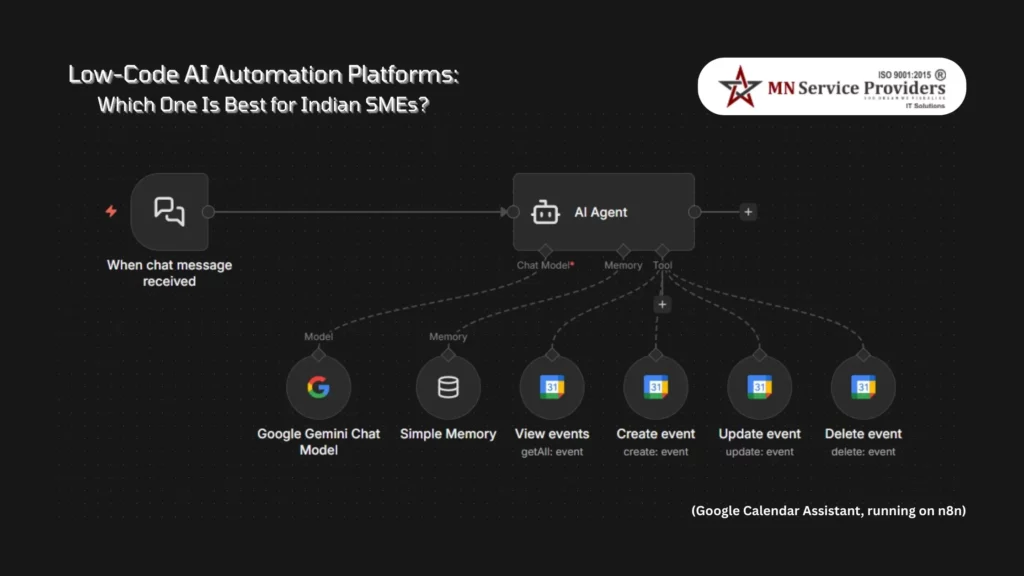
- n8n – Open-source automation tool with API-first design. Works well if you want control over data and logic.
- Tray.io – Powerful workflow platform that supports complex processes and branching logic.
They let you build custom workflows beyond basic triggers. They need someone semi-technical to configure and maintain, but can scale without huge costs.
Category 3: Enterprise-First Platforms (Overkill for Most SMEs)
Built for:
- Large teams
- Regulated industries
- Heavy compliance
Problems for SMEs:
- Complex licensing
- Long setup cycles
- High consulting costs
They look impressive in demos.
They drain energy in real life.
Unless you’re already operating at scale, skip this category.
The “best” platform is useless if your team avoids using it.
Examples:
These are full-blown automation suites built for large teams and compliance needs.
- UiPath – A leader in automation for structured enterprise use cases, with strong RPA and workflow capabilities.
- Automation Anywhere – Another enterprise automation giant focused on regulated environments and large-scale deployments.
They’re powerful — but expensive and complex. For most Indian SMEs, they’re like using a bulldozer to plant a garden.
Why the Indian Context Changes Everything
Reality #1: WhatsApp is the operating system
- Leads
- Orders
- Support
- Follow-ups
Everything happens there.
This is why WhatsApp-first automation matters — not chatbots that replace humans, but assist them.
Indian providers are already moving this way .
Every serious AI automation agency in India builds around this.
Reality #2: Data is messy
- Voice notes
- Photos of invoices
- PDFs
- Scans
This is where AI shines — not dashboards.
AI can:
- Extract meaning
- Clean inputs
- Categorise chaos
Structured-data advice doesn’t work here.
Indian data isn’t neat. And that’s okay.
Reality #3: Price sensitivity is real
Hidden costs kill trust:
- API tokens
- Failed runs
- Silent upgrades
Predictable pricing is a massive trust builder.
Ask any AI automation agency in India — pricing anxiety is the #1 blocker.
Common Mistakes Indian SMEs Make
Mistake 1: Buying AI before fixing processes
Many SMEs jump straight into AI because it sounds powerful. But when steps aren’t defined, ownership isn’t clear, and exceptions aren’t documented, AI has nothing solid to work with. The result is confusion, not efficiency. You don’t need intelligence first. You need order. Automation should stabilise the process before AI is asked to “think”.
Mistake 2: Choosing tools based on YouTube hype
A slick demo or a viral video makes every tool look magical. What those videos don’t show is the context — team size, data quality, or long-term effort. SMEs copy setups that worked for very different businesses and then wonder why nothing fits. Tools aren’t universal. Your workflow matters more than someone else’s success story.
Mistake 3: Ignoring long-term costs
Low monthly pricing feels safe, until usage grows. API calls, AI tokens, failed automation runs, premium connectors — they add up quietly. Six months later, the tool that felt “cheap” is eating into margins. Many SMEs don’t budget for scale, and that surprise bill kills trust in automation entirely.
Mistake 4: Assuming no-code means no thinking
No-code removes programming, not responsibility. Someone still needs to design the flow, handle exceptions, and decide what happens when data is incomplete or wrong. When no one owns that thinking, automations rot. This is how automation debt builds — not because the tool is bad, but because nobody was accountable for keeping it useful.
Yes, automation debt is real.
Bad early decisions cost more later — something every AI automation agency in India sees during clean-ups.
A Practical Decision Framework
Ask yourself:
- Team size?
- Monthly automation budget?
- Data sensitivity?
- WhatsApp or local integrations needed?
- Technical comfort level?
If you’re here, start here:
- Small team, low budget → Plug-and-play
- Growing ops, cost control → Flexible workflow builder
- Heavy compliance → Enterprise (only if needed)
No tool names.
Just starting paths.
That’s how a responsible AI automation agency in India advises clients.
A Realistic Automation Use Case
Let’s walk through it.
- Lead comes via WhatsApp
- Details captured automatically
- AI cleans and categorises info
- Follow-up reminder created
- Owner sees everything in one view
Why this works:
- Low risk
- Immediate ROI
- Confidence-building
We’ve seen this save 3 – 4 hours daily, reduced to minutes.
That’s not theory.
That’s field reality from every AI automation agency in India worth trusting.
So… Which One Is Best?
Here’s the honest answer.
There is no single “best” platform.
The best platform is:
- One you can manage
- One your team uses
- One that still works after 6 months
Final framing
The best low-code AI platform is the one your business survives with — not the one that looks smartest today.
Every seasoned AI automation agency in India agrees on this.
Next Steps (Without Breaking Your Business)
Do this instead of overthinking:
- Start with one process
- Assign one owner
- Pilot before scaling
- Get expert help for setup — not control
Ask yourself this tonight:
Which task do you repeat every day that should not need a human anymore?
That’s where automation begins.
That’s where a good AI automation agency in India starts the conversation.
Want to go deeper?
Share this with a founder friend.
Comment with the process you hate doing daily.
Or contact MN Service Providers to get solutions to your automation needs.
References
- 73 % MSMEs report business growth via digital adoption, led by UPI and smartphones.
- AI adoption by small and medium‑size enterprises.
- WhatsApp to develop AI chatbot for MSMEs with India SME Forum & Ministry.
- Digital Divide: MSMEs struggle to tap into AI revolution as high costs block access.
- 50+ RPA Statistics You Need to Know.
- Use of Artificial Intelligence in Enterprises.

Melvin C Varghese is an author with more than 8 years of expertise in DevOps, SEO and SEM. His portfolio blogs include a Digital Marketing blog at https://melvincv.com/blog/ and a DevOps blog at https://blog.melvincv.com/. He is married with 2 small kids and is a simple person who eats, sleeps, works and plays. He loves music, comedy movies and the occasional video game.