
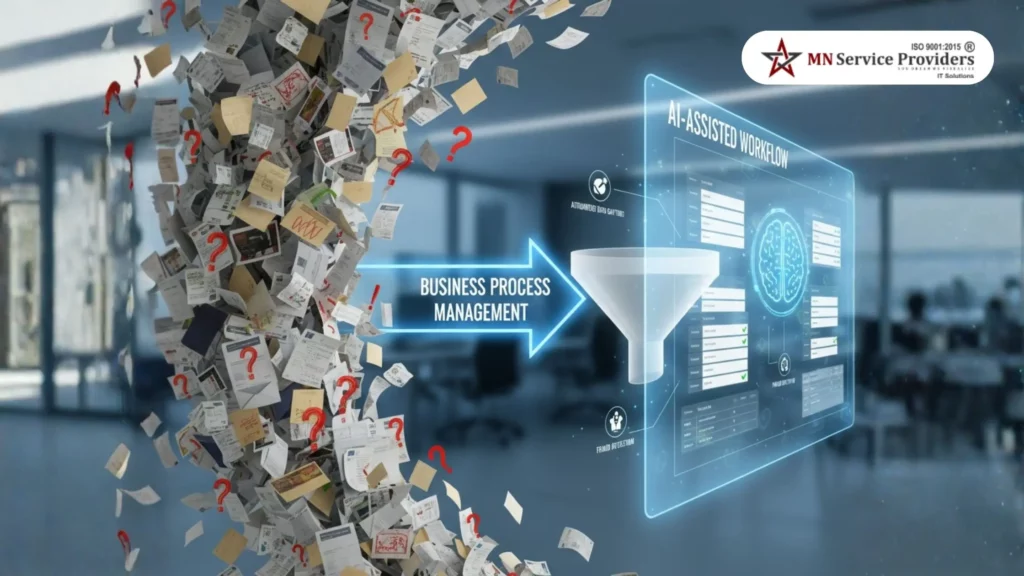
AI (Artificial Intelligence) can help you read invoices faster. But Business Process Management is what fixes the real problem: too many follow‑ups, too many unclear steps, and too much time wasted trying to find who has the invoice now.
If your Bangalore team wants invoices to move in a predictable way (instead of “we will approve it soon”), combine AI data reading with Business Process Management steps for intake, checks, approvals, reminders, and record‑keeping—start to finish.
The promise
AI + Business Process Management reduces invoice chasing by giving every invoice one clear path:
Capture → Validate → Approve → Pay
This is not magic. It does not mean “no humans needed.”
It simply means fewer delays and fewer messages like “Please approve today.”
If your approvals and problem cases are messy, better scanning (OCR—Optical Character Recognition) will not save you. That is why Business Process Management matters.
Why this matters now, in Bangalore
Invoices don’t arrive in one neat format. They come from many places:
- PDF invoices through email
- Printed invoices that get scanned
- Photos taken on phones
- WhatsApp forwards
Bangalore companies move fast, but finance must still be correct. In India, invoices often need details like:
- GSTIN (Goods and Services Tax Identification Number)
- HSN/SAC (product/service codes used for GST)
- Correct tax split (CGST/SGST/IGST)
- E‑invoicing rules (when applicable)
This is where Business Process Management helps: it turns daily firefighting into a repeatable routine.
What “AI powered BPM” is (and is not)
Many people think invoice automation is only about “how accurate the scan is.” That’s only one part.
AI helps with:
- Reading important invoice details (vendor name, invoice number, dates, amounts, tax details)
- Finding common issues (missing fields, mismatched totals, duplicates)
Business Process Management handles what AI cannot safely handle on its own:
- Making sure the invoice follows the same steps every time
- Sending it to the right people for approval
- Handling problems without long email threads
- Keeping a clear record of actions (who did what, and when)
So, AI reads and suggests. Business Process Management moves the invoice through the business in a controlled way.
Also, scanning alone does not remove review. Most teams still want a review step before approval or payment. That is why Business Process Management works best when humans are included in the process from the start.
The real bottleneck: approvals + exceptions
Scanning an invoice is easy to notice. Approvals are easy to ignore—until everything gets stuck.
Approvals usually stall because:
- Nobody wrote down the approval limits (DoA—Delegation of Authority)
- Too many special cases (urgent buys, no purchase order, vendor re‑sending invoices)
- Nobody knows who owns a problem, so it keeps bouncing around
That is the heart of Business Process Management: removing confusion.
A useful shift in thinking:
- Stop chasing “touchless AP” (Accounts Payable with zero human work)
- Start building “clear handling of exceptions” (clear actions when something is wrong)
A practical Bangalore workflow (step by step)
Step A — Centralise intake (one front door)
Decide the “front door” for invoices, then push everything into it:
- Email (AP@…)
- Upload link (vendor portal or form)
- Scan/photo upload
- WhatsApp‑style intake (structured, not casual)
Business Process Management starts here: one queue, one source of truth.
Step B — AI extraction with guardrails
Extract common fields plus India‑specific essentials:
- Vendor GSTIN, your GSTIN
- HSN/SAC
- Tax breakup (CGST/SGST/IGST)
- Place of supply
- Invoice number/date, taxable value, total
Then route to a review step before posting or approval.
Step C — Validation rules (simple, strict)
Add simple checks that catch most problems early:
- Mandatory field checks (don’t proceed if key details are missing)
- Duplicate detection (same vendor + invoice number + amount)
- PO vs non‑PO check (Purchase Order vs no Purchase Order)
- Basic GST logic checks (example: tax type matches place of supply)
- Amount mismatch checks (line total vs invoice total)
Step D — Exception taxonomy (the missing template)
Most teams have “issues.” Few teams have a named list of issues.
Create a short list of common exceptions so the team always handles them the same way, for example:
- Missing GSTIN
- Missing HSN/SAC
- Wrong tax split
- Duplicate invoice
- PO mismatch
- No PO attached
- E‑invoicing upload error
This is where Business Process Management becomes practical: the problem is named, owned, and tracked.
Step E — Approval design (minimum viable DoA)
Keep approvals simple so they actually work:
- Tier 1: Department approver (budget owner)
- Tier 2: Finance approver (checks tax + correct accounting)
- Tier 3: Senior approval only for high‑value or exception cases
This is where Business Process Management wins: fewer layers, clear rules, and automatic reminders/escalation if someone delays.
Step F — Audit trail + role separation
Track:
- Who reviewed the invoice
- What was changed
- Who approved (and when)
- Why a problem invoice was accepted
Good Business Process Management makes this automatic, instead of forcing you to search old emails during audits.
Step G — Integrations (keep it practical)
Do what is practical right now:
- Connect to your accounting system if possible, or
- Export clean data (Excel/CSV/JSON) that your finance team can upload
The workflow tool manages movement and approvals. The accounting tool remains the main record.
Step H — From approved to paid (do not ignore payments)
Payments can also cause delays:
- Bank approval steps
- Vendor bank details/UPI details
- Cash‑flow timing
The goal is not “one‑click payment.” The goal is one controlled flow so nothing gets lost after approval.
Reliability + compliance (the “IRP is down” playbook)
Sometimes the e‑invoicing system is slow or unavailable. Work still must continue.
A simple plan:
- Queue + retry (try again later automatically)
- Manual override for authorised users (for urgent cases)
- Clear reason codes (why it failed)
- Audit trail always on (every override is recorded)
Reliability is not a “feature.” It is how the process is designed. That is Business Process Management doing the unglamorous work.
Implementation plan (30–90 days)
30-day pilot (small scope, strong controls)
- Pick one unit or one vendor group
- Centralise intake into one queue
- Add validations + duplicate detection
- Start a simple DoA with delegation and escalation
- Track turnaround time and top exceptions
60–90 day scale (add depth where it matters)
- Expand to more units/vendors
- Improve the exception list based on real data
- Add integrations and automated posting/export
- Improve reporting (where approvals stall, which issues repeat)
MN Service Providers offers Digital Transformation, Business Process Automation, Artificial Intelligence, and Data Science services that support building these controlled invoice workflows.
Self-assessment checklist (use this before you buy anything):
- How many invoice intake sources exist today?
- What are the top 5 issues your team faces?
- Is your DoA written down?
- Can you prove who approved what within 2 minutes?
- Do you need accounting sync, or is a clean export enough for now?
If any of these answers feel uncomfortable, Business Process Management is not “extra.” It is the fix.
References
- e-Invoice System (Govt. of India) — https://einvoice.gst.gov.in/
- GST Portal (Goods and Services Tax, India) — https://www.gst.gov.in/
- Central Board of Indirect Taxes and Customs (CBIC) — https://www.cbic.gov.in/
- IMARC Group — India e-Invoicing Market Report — https://www.imarcgroup.com/india-e-invoicing-market
- World Economic Forum — Transforming Small Businesses: An AI Playbook for India’s MSMEs — https://www.weforum.org/publications/transforming-small-businesses-an-ai-playbook-for-india-s-msmes/
- Nividous — Accounts Payable Process Automation case study — https://nividous.com/resources/case-studies/accounts-payable-process-automation-for-a-leading-manufacturing-company
- ABBYY — Invoice Processing and OCR solutions — https://www.abbyy.com/solutions/invoice-processing/
- NASSCOM — Resources on AI and digital adoption in India — https://nasscom.in/

Melvin C Varghese is an author with more than 8 years of expertise in DevOps, SEO and SEM. His portfolio blogs include a Digital Marketing blog at https://melvincv.com/blog/ and a DevOps blog at https://blog.melvincv.com/. He is married with 2 small kids and is a simple person who eats, sleeps, works and plays. He loves music, comedy movies and the occasional video game.